
Clinical operations begins when the study team turns the protocol into daily practice. A protocol can describe the scientific plan with precision and still leave a great deal unresolved for the people who have to run the study. Someone has to translate the visit schedule into clinic flow and make sure the right version of the consent form is available before a participant signs it. Another person may need to understand how a lab result moves from the site to the database, how a safety event moves from the investigator to the sponsor, how a shipment issue becomes a risk to enrollment, and how a monitoring signal becomes a corrective action instead of a recurring problem. That is clinical operations. It is the work of making a clinical study executable and inspectable. The study record preserves the evidence the team needs to understand a problem and support recovery.
Different organizations place different boundaries around the function. At one sponsor, clinical operations may include start-up, monitoring, vendor oversight, and study management, while another may keep start-up separate and assign monitoring to a CRO. That second sponsor may share vendor oversight across procurement and data management or place it with quality. Sites use the same word for coordinators, research nurses, regulatory staff, investigators, and managers who keep the study moving inside the institution.
The title matters less than the operating problem. A study needs a group of people who can connect the protocol, the participant experience, the investigator's responsibility, the sponsor's oversight, the CRO or vendor model, the data flow, the safety process, and the study record. When those connections are weak, ongoing enrollment and visits may keep the study looking active on dashboards even as the work starts to lose shape. Records drift from reality as decisions happen outside the evidence trail. Handling risks as isolated tasks leaves the study-level signals unaddressed. Clinical operations is the discipline that keeps those connections visible.
From protocol to operational work
The protocol is the controlling plan for the study and tells the study team what must happen. Translating that plan into real work requires role-specific instructions for current conditions.
A protocol may require a procedure at a defined visit. Clinical operations has to ask where that procedure happens, who is trained to perform it, what source record captures it, how the result reaches the sponsor, what happens if the participant misses the window, and how the issue is documented. A protocol may describe eligibility criteria. Clinical operations has to make sure screening staff understand those criteria and that source records support the eligibility decision. The randomization or enrollment system must be used correctly, with a questionable case escalated before the wrong participant enters the study.
The work starts with translation. Good translation is practical and detailed. It turns protocol requirements into workflows, trackers, training, monitoring focus, system configuration, delegation, site instructions, vendor tasks, and evidence. Poor translation leaves each function to make local guesses. The guesses may be reasonable on their own and still fail as a system.
Consider a study that uses a central laboratory and an electronic diary, with a home health vendor added to the model. The protocol may list the required assessments. The operations team has to decide how the participant is trained, how kits are shipped, how missed diary entries are reviewed, how home visit documentation reaches the site, how abnormal results are routed, and how the investigator retains appropriate oversight. None of those questions belongs to one function alone. They sit between clinical operations, data management, safety, medical monitoring, vendors, the site, and the investigator.
The strongest clinical operations teams identify handoffs before failure and assign them during start-up. They monitor each handoff during conduct and close it during archiving.
The work is broader than timelines
Clinical operations is often judged by timelines because timelines are easy to see. First site activated. First participant enrolled. Database lock. Closeout complete. Those milestones matter. They do not describe the whole job.
A study can hit a date while building risk into the record. A rushed start-up can activate a site before a training gap is understood. Enrollment pressure can move screening forward before eligibility documentation is clean. A database can look close to lock while source questions remain unresolved at sites. A vendor can meet a delivery date while the sponsor still lacks clear evidence of oversight.
The work of clinical operations is to manage both motion and control. Motion means the study progresses. Sites are selected, contracts move, systems open, participants are recruited, visits happen, data are entered, queries are resolved, vendors perform, and closeout advances.
Control means the study remains aligned with the protocol, applicable requirements, participant protection, data reliability, and the record that will later explain what happened. Control gives a study the discipline to move without losing its proof; delay alone is not control.
For that reason, project coordination forms one part of clinical operations. The broader discipline includes judgment about risk, responsibility, documentation, escalation, and recovery. It requires a feel for where a small operational issue can become a participant issue, a data issue, a quality issue, or an inspection issue.
A missing temperature log can become a product-control issue if the investigational product depends on controlled storage. Late monitoring follow-up can put participant protection at risk when consent documentation or eligibility is affected. A safety-reporting problem creates the same risk. Vendor file-transfer failures can become data-interpretation issues when the missing data are needed to assess an endpoint or trigger a safety review. Clinical operations sees these problems in context.
Five recurring responsibilities
The work varies by study and organization, but five responsibilities return throughout the lifecycle.
First, clinical operations turns requirements into executable plans. The protocol, informed consent process, monitoring strategy, safety plan, data collection plan, vendor specifications, country requirements, and sponsor procedures have to become work that people can perform.
Second, clinical operations keeps roles and handoffs clear. A study rarely fails because nobody was assigned to anything. Failure more often begins with vague assignments or unrealistic expectations. Disconnected work across functions compounds it. In one common pattern, the site believes the sponsor owns a task while the CRO expects the vendor to act. The vendor, meanwhile, believes the site has already confirmed it.
Third, clinical operations watches for operational risk. Some risks are obvious at the beginning, such as complex procedures, narrow eligibility criteria, unusual product handling, or heavy participant burden. Others appear during conduct, such as repeated missed assessments, slow query response, enrollment concentrated at one site, monitor findings that repeat, or vendor data arriving late.
Fourth, clinical operations preserves the study record. The record is the evidence trail that allows the study team, the sponsor, inspectors, auditors, and later reviewers to understand the plan and what was done. The trail also shows what changed and identifies who made decisions. It connects those facts to how issues were handled.
Fifth, clinical operations helps the study recover. Recovery requires the hard work of identifying the real issue, protecting participants, correcting the immediate problem, preventing recurrence where appropriate, documenting the decision, and making sure the fix reaches the people who need to change their work.
These responsibilities overlap across the lifecycle. A monitoring visit may reveal a training problem, a system configuration issue, a source documentation gap, and a vendor communication failure. A good operations team looks for a shared cause across those four problems.
Clinical operations across the lifecycle
The most useful way to understand clinical operations is as a lifecycle discipline. The work begins before the first site is activated and continues after the last visit has occurred.
Before a study opens, clinical operations helps test whether the protocol can be run. This includes the obvious questions about timelines and site capacity. Enrollment remains part of the decision. It also includes quieter questions that often become larger later. Can the visit schedule fit real clinic flow? Can the site produce the required source records? Will a vendor touch participant-facing work? Does the study require a system the site has never used? Are there procedures that need special training, space, equipment, supplies, or backup plans? If a decentralized element is used, the team must define data visibility and review ownership. The plan also needs to identify who follows up and how the investigator stays appropriately involved.
During start-up, the clinical operations team coordinates the work needed to activate the study. That work may include site communication, feasibility follow-up, document collection, training coordination, system access, delegation, vendor setup, investigational product readiness, budget and contract handoffs, IRB or ethics tracking, and activation decisions. The exact ownership varies. The operating need remains constant. Activation should follow only when the site is ready to conduct the study as approved and documented.
Once conduct begins, clinical operations watches the study under pressure. Enrollment pressure, visit windows, staffing gaps, system problems, vendor delays, protocol changes, safety events, data issues, and monitoring findings all compete for attention. The operational skill is to keep the work moving while noticing which issues matter most. A missed administrative update may need follow-up. A repeated consent version problem needs a different level of attention. A one-time vendor delay may be manageable. A pattern of late vendor data can affect monitoring, data review, safety interpretation, or endpoint confidence.
Closeout requires clinical operations to help the study explain itself after active conduct ends. Sites need appropriate closure. Records need custody. Queries, outstanding issues, product accountability, vendor deliverables, data transfers, public records, and archive instructions have to line up. The closeout period is where many teams discover whether the earlier record was controlled well enough.
This lifecycle view matters for students and new professionals because it shows where their work fits. It matters for experienced professionals because it prevents narrow problem solving. A study issue rarely respects department boundaries. A start-up shortcut can become a monitoring issue. A monitoring issue can become a data issue. A data issue can become a closeout issue. A closeout issue can become an inspection-readiness issue.
Clinical operations keeps each function distinct while making the lifecycle visible enough to manage the handoffs.
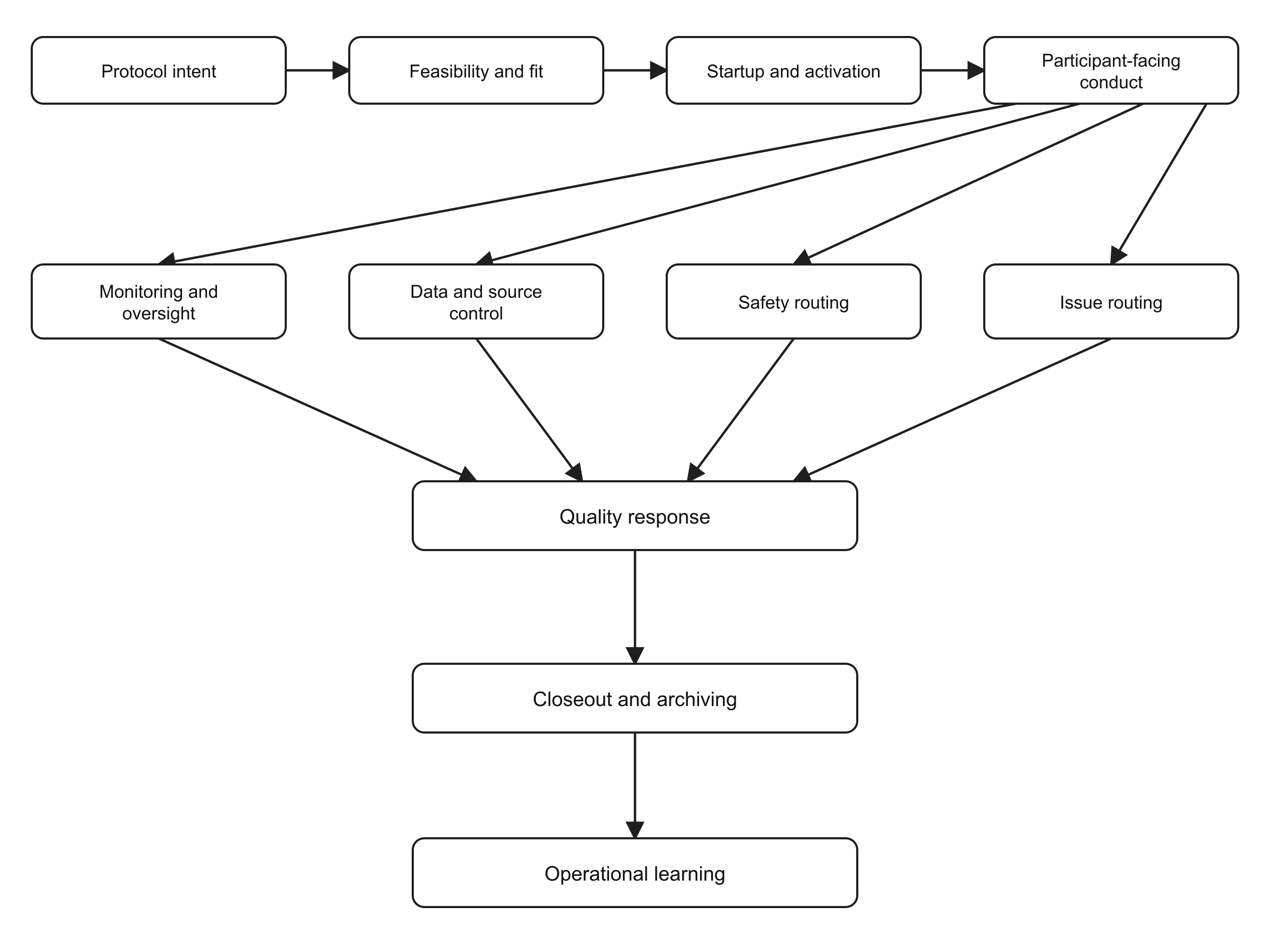
Figure description
Protocol intent leads through feasibility and start-up into participant-facing conduct. Conduct branches into monitoring, data and source control, safety routing, and issue routing. These branches feed quality response, followed by closeout and archiving. Operational learning follows the completed record.
The same study looks different from different seats
One reason clinical operations is difficult is that every role sees the study through a different operational lens.
At the site, the study is experienced through participants, clinic space, investigator availability, source documentation, procedures, visit windows, local systems, pharmacy, laboratories, and institutional rules. The site has to make the study fit into a real clinical environment.
At the sponsor, the study is experienced through oversight, risk, enrollment, data quality, safety review, vendors, budgets, timelines, governance, regulatory commitments, and the final study record. The sponsor has to keep the full study visible across sites, countries, service providers, and functions.
At the CRO or FSP provider, the study is experienced through delegated work, performance expectations, communication pathways, issue escalation, monitoring deliverables, start-up deliverables, project controls, and evidence that the delegated work was performed.
At a vendor, the study is experienced through a narrower service line, such as central labs, imaging, eCOA, IRT, home health, translation, logistics, or technology support. The vendor may control an essential part of the study, while still seeing only part of the study.
At the investigator or medical monitor level, the study is experienced through participant protection, protocol conduct, safety information, medical review, eligibility, and the clinical meaning of events.
None of these views is complete by itself. Clinical operations has to understand enough of each view to manage the places where they meet.
The practical example is simple. A participant misses a scheduled assessment in a study that uses site visits and a central lab, with a participant-facing electronic tool in use. The site sees a scheduling and participant follow-up problem. The monitor sees a protocol compliance and source documentation question. Data management sees missing data. The vendor sees an incomplete transmission, while the medical monitor may need to know whether the missing information affects safety interpretation. A sponsor that sees the same issue across several sites sees a pattern.
Clinical operations gives the work a structure while responsibility remains distributed across roles. Each role knows what to do, where to document, when to escalate, and how the issue affects the rest of the study.
Ownership and participation
Clinical operations participates in many areas it does not fully own. That distinction matters.
Regulatory affairs may own submissions or specific regulatory strategies. Clinical operations still needs to understand how approval timing affects start-up, amendments, country activation, and site instructions. Data management may own database design and edit checks. Data cleaning remains within its work. Clinical operations still needs to understand how source data, visit flow, query response, and monitoring affect data quality. Safety may own pharmacovigilance processes and aggregate safety review. Clinical operations still needs to understand site reporting, investigator assessment, safety routing, and urgent escalation.
Quality may own audits and quality systems. Clinical operations still needs to run the study in a way that creates a coherent evidence trail. Finance and contracts may own budget language and payment terms. Contracting mechanics remain with them. Clinical operations still needs to understand how coverage analysis, participant reimbursement, site payments, and vendor transitions affect start-up and conduct.
The phrase "cross-functional" can be both useful and weak. It is useful because studies require multiple functions. It becomes weak when it hides the need for clear accountability. A cross-functional issue still needs an owner for the next action and a decision path. A record is still needed for what follows.
Clinical operations often sits closest to the operational consequences of cross-functional decisions. A protocol amendment may be a medical or regulatory decision, but clinical operations has to help answer when sites can implement it, which documents change, how participants are reconsented if needed, what happens in the systems, what vendors need to update, and how monitors confirm adoption. A vendor change may be a sourcing decision, but clinical operations has to help manage service continuity, data transfer, site communication, training, and risk.
The best operations leaders make ownership visible across functions, with their own responsibility clearly bounded within that allocation. They carry decisions through handoff with enough specificity for the receiving team to use them.
Many study decisions sound clear when everyone is in the same meeting. They become weaker when they reach a site, a monitor, a vendor help desk, a data manager, or a replacement team member who was not present. "The site will follow up" works in conversation. It fails in execution unless the team names the person to contact, the timing, the document, the system, the evidence, and the escalation path if the answer does not come back.
Clinical operations makes the right decisions usable without lengthening every decision. That often means adding a level of operational specificity before the decision leaves the room. A study team may decide to retrain sites on a procedure. The useful operational version names the audience, the required material, the delivery method, the completion evidence, the timing, the owner, and how monitors or study managers will know whether the problem has changed. A team may decide to ask a vendor for a corrective action plan. The useful operational version names the service failure, the impacted studies or sites, the interim control, the owner on each side, the due date, and the evidence that will show the corrective action worked.
Turning a good intention into an executable instruction is a clinical operations skill that often improves the work.
The record is part of the work
Clinical operations lives close to the record because the record is how the study explains itself later.
A study record is built from many smaller records: protocol versions, consent forms, delegation logs, training evidence, monitoring reports, issue logs, vendor oversight records, source records, data changes, safety correspondence, product accountability records, approvals, amendments, closeout evidence, and public-record submissions where applicable. Each record has a purpose. Together, they show whether the study was conducted with appropriate oversight and whether the data can be understood.
A weak record can reflect sound conduct and still make that conduct harder to defend. A strong record helps the team see and correct problems earlier, although it cannot rescue poor conduct. The purpose is a record that reflects the study accurately enough that another qualified person can understand the conduct without relying on memory.
This matters because clinical trials are long. People change roles, sites turn over staff, vendors rotate team members, and monitors move on. Protocol amendments and system updates change the work itself. A decision that made sense on a Tuesday afternoon can become unclear months later if the reasoning was not documented and the downstream owners were not informed.
Clinical operations protects continuity. That continuity has practical consequences. When a monitor reviews a site file, the documents should tell the same story as the source and system records. When a safety question is reviewed, the event history should be traceable. When a participant was reconsented, the timing and version should make sense. When a vendor provides a transfer file, the team should know the file's contents, including the boundary created by its exclusions, and how the file was checked. When a study closes, the archive should preserve the records needed under the applicable framework while preserving their meaning instead of merely moving files into storage.
The basic point is that records belong inside study conduct.
Quality starts earlier than most teams want to admit
Quality problems often appear late, but they usually begin earlier. An inspection-readiness problem may begin as an unclear responsibility during start-up. A data-quality problem may begin as a visit workflow that never matched the eCRF design. A safety escalation problem may begin as training that did not explain who reports what to whom. A recruitment problem may begin as eligibility criteria that were feasible on paper and unrealistic in clinic flow. A vendor oversight problem may begin as a contract or specification that described deliverables without clarifying the evidence or escalation path. The review process may be unclear as well.
Clinical operations improves detection and recovery across many issues, even when prevention remains imperfect. ICH E6(R3) and related quality guidance place strong emphasis on designing quality into the trial, focusing on critical-to-quality factors, using proportionate approaches, and keeping participant protection and reliable results at the center of the work. For clinical operations, quality starts when the team decides how the protocol will be run and continues through conduct. A late-stage inspection cannot create what the design omitted.
Quality by design sounds abstract until it reaches daily work. It means asking whether a site can perform the procedure as written. It means deciding which data and processes matter most to participant protection and reliable interpretation. It means avoiding unnecessary complexity where it does not improve the study. It means building monitoring, vendor oversight, training, and data review around meaningful risks instead of treating every task as equally important.
Clinical operations remains separate from the quality department while serving as one of the places where quality either becomes real or remains a document.
Clinical operations is a translation role
The best clinical operations professionals translate constantly. Protocol language becomes site work through that translation, while site friction has to be understood as sponsor risk. Monitoring findings become corrective action; data problems prompt operational questions. Vendor issues have study consequences that clinical operations must explain alongside the practical controls required by regulatory and quality expectations. Leadership pressure still has to result in decisions the study team can execute without damaging the record.
Translation requires enough fluency across functions to know when a word means different things to different groups. "Source" does not mean the same thing in a clinic note, an eCRF, an EHR interface, and a submission dataset. "Reported" can mean reported to the sponsor, reported to an IRB, reported to FDA, entered in a database, discussed with a medical monitor, or documented in a monitoring report. "Complete" can mean visit complete, data entry complete, query complete, monitoring follow-up complete, vendor transfer complete, or record complete.
Clinical operations gets into trouble when these words stay vague. A strong operator slows down enough to ask what the word means in that context and who is responsible for the next action. That habit is one of the differences between task management and operational judgment.
How this field guide uses the map
The rest of this book follows the work through the lifecycle. The early chapters build the operating environment: rules, expectations, product type, organizational models, and roles. The next group follows the study from protocol planning through feasibility, start-up, infrastructure, and finance-adjacent operations. The middle chapters focus on the participant-facing and site-facing work: recruitment, consent, privacy, source, product handling, deviations, and safety. The oversight chapters cover monitoring, data flow, vendors, quality, CAPA, audits, and inspection readiness. The final chapters cover closeout, leadership, decentralized elements, digital operations, analytics, and the limits of what can be claimed safely from current sources.
The book does not try to make every reader an expert in every function. A CRC does not need to become a regulatory strategist to understand why an amendment creates operational risk. A CRA does not need to become a data standards programmer to understand how source flow affects later data review. A CTM does not need to become a privacy lawyer to know when a data-access question needs escalation. A PI does not need to manage every system detail personally to understand why oversight cannot be delegated into invisibility.
The field guide aims for practical fluency. Practical fluency means knowing enough to see the handoff, ask the right next question, document the decision, and involve the right owner. It means recognizing when a problem is local and knowing when a checklist is hiding a larger issue. The same judgment depends on understanding that a study runs through the connections among its functions, systems, vendors, and files. Clinical operations is the discipline of those connections.