
Clinical operations works inside layers of rules, guidance, procedures, and judgment. The study team feels those layers every day, even when nobody is quoting a regulation.
They show up when a site asks whether a consent update applies to participants already enrolled and when a monitor finds a recurring documentation problem. A protocol amendment can make them visible when it changes a visit, a vendor changes a system, a participant-facing message needs IRB review, or a sponsor asks whether a public record has to be updated. The question is rarely just whether the team can perform the task. The question is which source of expectation is driving the task, who has authority to decide, how the decision affects participants and data, and what evidence the study record needs to preserve.
The rules come from different sources and do different jobs. A regulation may create a legal requirement. A guidance document may describe an agency's current thinking. ICH GCP may provide an international ethical and scientific frame for trial conduct. An IRB or IEC may impose conditions of approval. A sponsor SOP may be stricter than a general rule. A protocol may create a study-specific obligation. A site policy, contract, data-use agreement, pharmacy process, or vendor specification may control a practical step.
Clinical operations needs enough fluency to recognize which layer is in play and when to involve legal, regulatory affairs, quality, privacy, medical, or institutional reviewers.
Regulation, guidance, procedure, and judgment
The first habit is to separate source types. Regulations and statutes carry a different weight from guidance. Guidance can be extremely important. It often explains how an agency thinks about implementation, documentation, inspection focus, or acceptable approaches. But guidance usually does not operate the same way as a regulation unless a specific legal requirement is cited. Sponsor SOPs are different again. They may be built from regulation, guidance, company risk tolerance, inspection history, quality expectations, and internal operating choices. A sponsor SOP may require stricter controls than a general guidance example describes.
The protocol is another source of expectation. It is study-specific and approved through the applicable review path. Once the study is active, the protocol becomes one of the central operating documents. Clinical operations does not get to ignore a protocol requirement because it is inconvenient. It also should not improvise a change to the research activity without the right review and approval path.
Then there is professional judgment. Judgment fills the space between sources. It helps the team decide how to operationalize a requirement, how to sequence work, how to escalate risk, and how to document a decision. Judgment is valuable, but it is not a substitute for a source when a source controls the answer.
Many operational problems come from treating these source types as interchangeable. Local procedures may be credited to an external authority: a sponsor SOP to GCP, or a site's institutional policy to the IRB. Guidance raises a different source distinction when a team describes a recommendation as regulation. The practical risk is bigger than imprecise language. Imprecise language obscures who can approve a change and what evidence is needed. It also makes applicability at another site or country harder to judge.
Clinical operations should ask for the source without turning every conversation into a debate. A useful operating question asks the team to identify the driver. Regulation, guidance, SOP, protocol, IRB or IEC condition, contract, local policy, data agreement, or team decision. Once the driver is clear, the path usually becomes cleaner. It also prevents the team from building controls around the wrong source or escalating to the wrong owner.
When more than one framework applies
Some studies sit under multiple frameworks at the same time. That is where clinical operations can get into trouble if the team relies on slogans instead of sources.
A U.S. study may be FDA-regulated because it involves an investigational medical product. It may also involve an institution that follows Common Rule requirements because of HHS support or institutional policy. It may use protected health information held by a HIPAA covered entity or business associate. It may use a central IRB with local institutional dependencies still in place. It may include a public-registration obligation or a ClinicalTrials.gov consent statement. Depending on the facts, an HHS consent-posting obligation may apply. It is also possible that none of these obligations applies. A multinational study adds country, regional, language, importation, privacy, and ethics-review questions on top of the U.S. frame.
Applicability varies by study, and many studies do not carry the full set of obligations. Clinical operations still needs a method for recognizing overlap before the overlap becomes a late-stage finding.
Consider a protocol amendment that changes a participant-facing procedure and updates the consent form. The work is not finished when the protocol document is revised. The sponsor may need internal medical, regulatory, safety, clinical, data, and quality review. Sites may need IRB or IEC approval before implementation. The consent version may need translation or local formatting. Institution-specific language may also be required. The EDC, eCOA, IRT, laboratory requisition, pharmacy manual, monitoring plan, recruitment materials, or participant-facing app may need aligned changes. Site staff may need training before the new process is used. If the change affects already enrolled participants, the team needs a scoped decision on whether participants need updated information. That decision should establish when a revised consent signature is required and when a different communication path is appropriate.
The operational job is to see the connected work early and route questions to the right owners. The route followed by coordinators and CRAs should also govern the CTM's handling of questions. A clean record should show what was approved and when it took effect, including affected sites and participants.
Overlap also changes how teams should write and speak. "IRB approval is done" is too vague if local ancillary review, site activation, training, system release, or translated documents are still open. "Regulatory approved it" leaves a gap if the participant-facing material still needs IRB review. "The consent is approved" leaves a gap if the version in the site binder, eConsent platform, recruitment workflow, and translated packet are not aligned. Clinical operations should use language that shows the real operating state.
ICH GCP as an operating frame
ICH E6(R3) is one of the core sources for how this field guide frames clinical operations. Here, it is an operating frame for interventional clinical trials of investigational products intended for submission to regulatory authorities, and local law and regulation still matter.
Its value for clinical operations is that it connects ethics, science, quality, oversight, records, data, service providers, and participant protection. It pushes the study team away from mechanical compliance and toward quality built into the way the trial is designed and run. The concepts of quality by design, critical-to-quality factors, proportionality, appropriate oversight, data governance, and essential records change daily work.
Quality by design means the team should think about preventable problems before they become findings. Critical-to-quality thinking asks which processes and data matter most to participant protection and reliable results. Proportionality fits controls to the risk and importance of the process rather than the comfort level of the loudest stakeholder. Delegated work remains visible through oversight. Data governance requires planning for source, metadata, audit trails, access, transfers, retention, and final datasets rather than cleanup after the fact.
For clinical operations, ICH GCP works best when it becomes a set of operating habits. The team checks whether the protocol can be performed. It identifies the few processes that deserve special attention. It avoids creating unnecessary burden where the burden does not improve participant protection or data reliability. It documents roles and agreements. It watches service providers and vendors with enough evidence to know whether the work is under control. It treats essential records as part of study conduct rather than the administrative residue of conduct.
The same caution applies throughout the book. ICH GCP helps frame the work. Local legal questions still depend on the applicable FDA and HHS/OHRP requirements. IRB or IEC requirements remain part of the analysis, as do privacy law, sponsor SOPs, protocol requirements, and country-specific rules.
ICH E8(R1) reinforces the idea that quality should be designed into the study before conduct begins. Inspection alone cannot add it after the study is running. For operations, that idea is practical. A protocol that looks clean on paper can still create avoidable risk if the visit schedule is unworkable, the endpoint depends on a procedure the site rarely performs, the vendor handoff is vague, the participant burden is unrealistic, or the source documentation path is unclear.
Before activation, clinical operations contributes by asking whether sites can execute the visit schedule with the right staff and equipment. It can also test whether a participant-facing technology fits the population and setting while identifying the source records that will support critical data. A central lab process, home health visit, device training step, or imaging workflow may still need ownership before first participant first visit. These GCP principles help the team build quality into the conduct plan before deviations or monitoring findings force a response. Corrective action should not be the first trigger.
The discipline is to keep ICH language connected to real work. Critical-to-quality factors should become specific operational focus areas. Proportionality should become decisions about which controls are strong enough and which controls are unnecessary. Oversight should become evidence that delegated work was reviewed rather than a line in a contract. Data governance should become access control, source definition, audit trail review where applicable, transfer checks, and archive planning.
FDA-regulated studies and product-specific work
In U.S.-centered clinical operations, FDA-regulated studies are a major operating context. The work changes depending on whether the study involves a drug, biologic, device, or combination product. It also changes depending on whether the study is under an IND, an IDE, an abbreviated device pathway, a nonsignificant risk device framework, or another applicable structure.
Product type is covered in more detail in Chapter 3. Clinical operations should not use one generic trial rule for every study.
An IND drug or biologic study has sponsor and investigator responsibilities that do not map perfectly onto an IDE device study. Device studies bring different pathway questions, including significant-risk and nonsignificant-risk distinctions. Some forms and commitments apply in one context and not another. Safety reporting language differs. Record requirements and retention periods can differ. Product accountability looks different when the product is a drug kit, a biologic with temperature sensitivity, a device used in a procedure, or a combination product.
The team needs enough modality awareness to avoid applying the wrong template without requiring every ClinOps professional to become a specialist. A Form FDA 1572 belongs to a particular IND drug and biologic context. Device investigations use different investigator agreements and pathway logic. Safety terms such as suspected adverse reaction and unanticipated adverse device effect are not interchangeable. A start-up checklist built for one product type can create errors if it is reused without review.
The practical habit is to label the study correctly before building the work. Product type, regulatory pathway, geography, sponsor role, investigator role, IRB or IEC structure, and delegated responsibilities should be understood early. When those labels are unclear, the study can still move, but it moves with hidden risk.
The label affects ordinary work. It affects which forms are used, which commitments investigators make, how study product is controlled, how safety language is used, what the monitor reviews, what records are expected, and which questions need regulatory or quality input. A device study that involves a procedure, user training, device accountability, and a use-error concern does not operate like an oral drug study with centralized dispensing, while a combination product may force the team to pay attention to multiple operational vocabularies. A biologic or vaccine program may have handling, storage, excursion, and safety-review pressures that are different from a software-driven endpoint study.
Product classification belongs with the sponsor's regulatory and legal functions, together with FDA or other authorities when relevant.
Clinical operations should not wait until start-up to discover that the wrong operating template was used. If the site feasibility questionnaire, training plan, delegation log, pharmacy manual, device accountability process, monitoring plan, safety flow, and essential-record list were copied from a different product type, the mistake may not stay administrative. It can affect participant protection, protocol compliance, data reliability, and inspection readiness.
IRB and IEC work in human-subject protection
IRBs and IECs are central to participant protection, but they are not the same as sponsors, sites, investigators, regulators, or quality departments. They review research under their applicable framework, determine whether required criteria are met, review consent materials and participant-facing information, and may require changes or conditions before research proceeds.
For U.S. FDA-regulated clinical investigations, FDA regulations in 21 CFR Parts 50 and 56 shape informed consent and IRB expectations. For HHS-conducted or HHS-supported research covered by the Common Rule, 45 CFR 46 creates another framework. Many studies may need attention to multiple frameworks, and the frameworks should not be blended carelessly. The team should read each framework's language in light of its scope and any exceptions that apply.
Clinical operations often sits between the IRB or IEC decision and the people who have to implement it. That implementation work can include document version control, site instructions, consent process planning, recruitment material handling, amendment release, continuing review tracking where applicable, safety or unanticipated-problem routing, reliance arrangements, and evidence that the right approval was in place before the right activity occurred.
The risk is role confusion. A sponsor may prepare materials for IRB submission, but the investigator or institution may have responsibilities under local process. A central IRB may review for multiple sites, while local institutional requirements still affect activation or ancillary reviews. An IRB approval establishes that the approved research can proceed under the conditions and scope of that approval. Each remaining operational detail still needs a readiness check.
For clinical operations, IRB and IEC work creates records and communication. Timing remains part of the same work. The team has to know which version is approved, who approved it, when it can be implemented, whether participants need updated information, which sites are affected, and how changes flow into systems, training, vendors, and monitoring.
Approval also has a boundary. An IRB or IEC approval letter leaves separate operational work: updating the EDC, releasing a translated consent form, training site staff, revising the monitoring plan, activating a vendor change, and telling the pharmacy which version of a manual to follow. Those tasks need owners and dates.
The same boundary matters in the other direction. Sponsor urgency does not erase required review for an amendment. A site may prefer clearer participant language, but that preference does not make the revision approved for use. Technical readiness at a vendor should not outrun the study's review and implementation decision.
Clinical operations is often the function that catches these gaps because it sees the sequence. The regulatory team may see the submission. The IRB coordinator may see the approval letter. The site may see the participant visit. The vendor may see the system release. The monitor may see the version mismatch later. Clinical operations should make the sequence visible before the mismatch happens.
Consent and privacy in participant-facing work
Consent is often treated as a document. Operationally, it is a process with records around it. FDA informed consent, Common Rule informed consent, eConsent, HIPAA authorization, participant communication, recruitment materials, and public consent-form posting can touch the same study. They do not mean the same thing. A participant may sign an informed consent form to participate in research. A HIPAA authorization, where applicable, addresses permission to use or disclose protected health information. eConsent describes electronic systems and processes that may present information, support comprehension, document consent, and preserve materials. HHS consent posting under the Common Rule applies only in a scoped set of covered HHS-conducted or HHS-supported clinical trials. The ClinicalTrials.gov consent statement under FDA rules applies to a separate scoped set of applicable clinical trials.
These boundaries affect amendment handling and participant communications. If a consent form changes, the team needs to identify affected participants and apply the approved version. The applicable review decision determines whether reconsent or notification is required. Site instructions must address translated versions and explain how the record will show the process. If eConsent is used, the team needs to understand the signature step along with participant access, identity verification, IRB review of materials, archiving, privacy, security, and system evidence.
Privacy follows the same pattern. A data-sharing plan, EHR access, remote data capture tool, vendor transfer, or participant-facing app may raise questions for privacy, legal, regulatory, data governance, or institutional experts. Clinical operations should route the issue to those owners while keeping the operational impact visible. The study needs to know whether a vendor can access data, what data are transferred, whether participants are told, how access is controlled, and how the record reflects the arrangement.
The safe language is practical and scoped. Consent and privacy obligations depend on the study, institution, product, country, funding, data type, and applicable framework. A field guide helps the reader see the issue. It should not pretend to give legal advice.
Participant-facing materials deserve the same care. Recruitment copy, reminders, letters, visit instructions, payment or reimbursement language, app notifications, home-health scripts, and translated materials can look operational to the people producing them. They may still need review because they affect what participants are told and how the study is presented.
A good operations process treats participant communication as an approved, version-controlled study activity. It verifies approval for the study and applicable site or country. Language and participant group also need confirmation, with version control handled explicitly. It checks whether the material matches the current consent, protocol, visit schedule, reimbursement process, and system workflow. It keeps an archive of what was used and when. That record matters when a participant complains or a monitor asks how a site implemented a change. It also supports an auditor reconstructing what participants were told.
Remote and digital elements make the boundary more visible. A text reminder, telehealth visit, eConsent link, electronic diary, wearable sensor, or home nursing visit can be convenient. It can also introduce identity, privacy, source, access, training, data-transfer, vendor, and participant-support questions. The operational lesson is to plan the review path, system controls, user support, and evidence trail before the tool becomes part of participant experience.
Sponsor and investigator responsibility for delegated work
Clinical operations lives in the space between responsibility and delegation. Sponsors use CROs, FSP models, vendors, laboratories, technology providers, home health services, imaging providers, logistics partners, and consultants. Sites use coordinators, nurses, sub-investigators, pharmacists, research managers, and institutional support teams. Delegation is normal. It also creates risk when the team confuses delegation with disappearance.
ICH E6(R3) emphasizes that activities may be delegated or transferred, while appropriate responsibility and oversight remain important. U.S. FDA regulations also address sponsor and investigator responsibilities. Device sponsor duties appear in their own context. The exact wording differs by product type and regulation. Across those contexts, delegated work needs clear allocation, qualified people or providers, documented agreements where needed, oversight proportionate to risk, and evidence that the work was performed.
The investigator example is straightforward. An investigator may delegate study tasks to qualified staff. Delegation leaves investigator oversight in place. The site needs appropriate training, delegation documentation, supervision, source records, consent process control, product accountability where applicable, and issue escalation. The sponsor example is similar. A sponsor may transfer duties to a CRO or contract for vendor services. The sponsor needs a preserved record of the delegated or contracted work to assess whether it protects participants and supports reliable data.
Clinical operations converts responsibility into working controls. Responsibility becomes a delegation log, a communication plan, a monitoring plan, a vendor oversight plan, a training record, a meeting decision, a risk review, a documented escalation, or a corrective action.
The work should stay proportionate. A low-risk administrative handoff does not need the same controls as a participant-facing procedure, an endpoint assessment, a safety process, a product-handling step, or a system that generates source data. Proportionality, however, should not become a word used to excuse weak oversight. The team should be able to explain why the control fits the risk.
Delegation also has to be current. A delegation log signed at start-up does not prove that every later change was controlled. Staff departures or the addition of sub-investigators change who is on the site team. The work itself can also change: a coordinator takes on a task after training, a vendor changes a process, a remote vendor starts participant contact, or a central reader takes over an assessment previously performed locally. Each change can affect training, qualification, access, supervision, and records.
Oversight reaches the people and current processes behind the documents. The study team needs to know whether the people performing important work are authorized, trained, qualified for the task, and working under a current process. That applies at sites and at sponsors. It also applies to CROs and vendors, especially when their work touches participants, primary endpoints, safety review, investigational product, source data, or critical systems.
The strongest operations teams build checks into routine work before a monitoring visit or audit reveals drift: meeting actions, issue logs, training reviews, vendor metrics, monitoring follow-up, site contacts, system access reviews, and escalation notes. The artifact matters because the artifact is how the study later shows what happened.
Guidance and SOPs in the local rulebook
Sponsor SOPs and local site procedures are where many broad expectations become specific instructions. They define who does what in that organization. They also create obligations for the team that may be stricter than a general guidance discussion.
A person can be correct about an FDA guidance document and still be wrong about what the study team has to do. The sponsor SOP may require a particular approval path. The site may require a local review before a participant-facing material can be used. A data-use agreement may restrict transfer mechanics. A vendor contract may specify notice timing or a required report, with escalation using a defined path. Country teams may require language review before a document is released.
Clinical operations should know the local rulebook well enough to avoid familiar mistakes.
The protocol does not contain every operational requirement, so work also comes from other relevant sources, although an SOP cannot override an approved protocol or applicable requirement. Local practice creates a different risk when a team assumes that its process applies everywhere, even though a process that works at one sponsor or site may be wrong in another country.
The practical answer is traceability. When a requirement drives work, the team should know where it came from and where it is documented. The source may be a regulation, a guidance-informed SOP, an IRB condition, a protocol, a contract, a data privacy review, a pharmacy policy, or a vendor specification. For an important requirement, the record should make its connection to the resulting work clear enough for later review.
Traceability keeps important decisions from becoming oral history without demanding heavy paperwork for every small decision. When a CTM tells sites to pause a procedure, the file should show the decision, scope, reason, affected sites, and follow-up. A sponsor that accepts a vendor workaround should know whether quality, data, privacy, or regulatory review was needed. Differences in local site process need an acceptability decision and a recorded agreement.
The local rulebook should also be readable by the people doing the work. A beautiful SOP that nobody can apply under time pressure fails at the point of use. Study tools should translate source expectations into the right artifacts: current protocol version, consent version, training evidence, delegation record, system access, visit checklist, product-accountability record, monitoring follow-up, issue log, safety communication, vendor oversight file, and archive index. These are the objects clinical operations handles every week.
Global and country variation
Clinical operations becomes more complex when a study crosses countries. A multinational study needs local source review. Country variation can affect start-up sequence, ethics review, competent authority submissions, privacy and data protection, translations, importation, product handling, indemnity, insurance, participant materials, recruitment rules, remote activities, vendor models, safety routing, public registration, archiving, and closeout. The European Union Clinical Trials Regulation and CTIS matter for EU/EEA clinical trial operations. ICH E17 helps frame multiregional clinical trial planning. NIAID ClinRegs and country-specific resources help teams identify areas to investigate.
Local expertise remains necessary alongside those sources. A global study needs people who understand the specific country, institution, language, and authority context. Current local sources should determine country requirements.
When a study is global, operations planning must include local review early enough to change the plan. A procedure that is simple in one country may need additional approvals or translation in another. A remote process that works in one privacy framework may need adjustment elsewhere. A vendor that can provide a service in one region may not be able to provide the same service in another. A public-record requirement may differ by registry or sponsor policy. A local rule may impose another requirement.
If country review happens after the protocol, consent strategy, vendor model, and system design are already locked, the study may spend start-up time negotiating with decisions that should have been pressure-tested earlier. Translation needs may affect timelines. Privacy review may affect data flow. Importation or product-handling rules may affect pharmacy planning. Insurance or indemnity expectations may affect contracts. Ethics-review sequencing may affect activation. A remote element may need local adjustment even when the technology works well elsewhere.
Country-by-country instructions become outdated quickly and remain incomplete. A useful habit is to document the questions that need local answers and assign them before they block activation or participant conduct. For multinational studies, "local review pending" describes a real operational state with unresolved work.
Using rules without freezing the work
Rules can make teams cautious in the wrong way. Fear of being wrong can delay decisions, while over-escalation slows the study. Teams may also create extra trackers and approvals. A larger document collection can leave the integrity of the study record unchanged; volume alone does not improve participant protection or data reliability.
Rules can also be underused. A team may move quickly because the operational pressure is real while missing the review and approval path that gives the work legitimacy. Documentation supplies the evidence for that path.
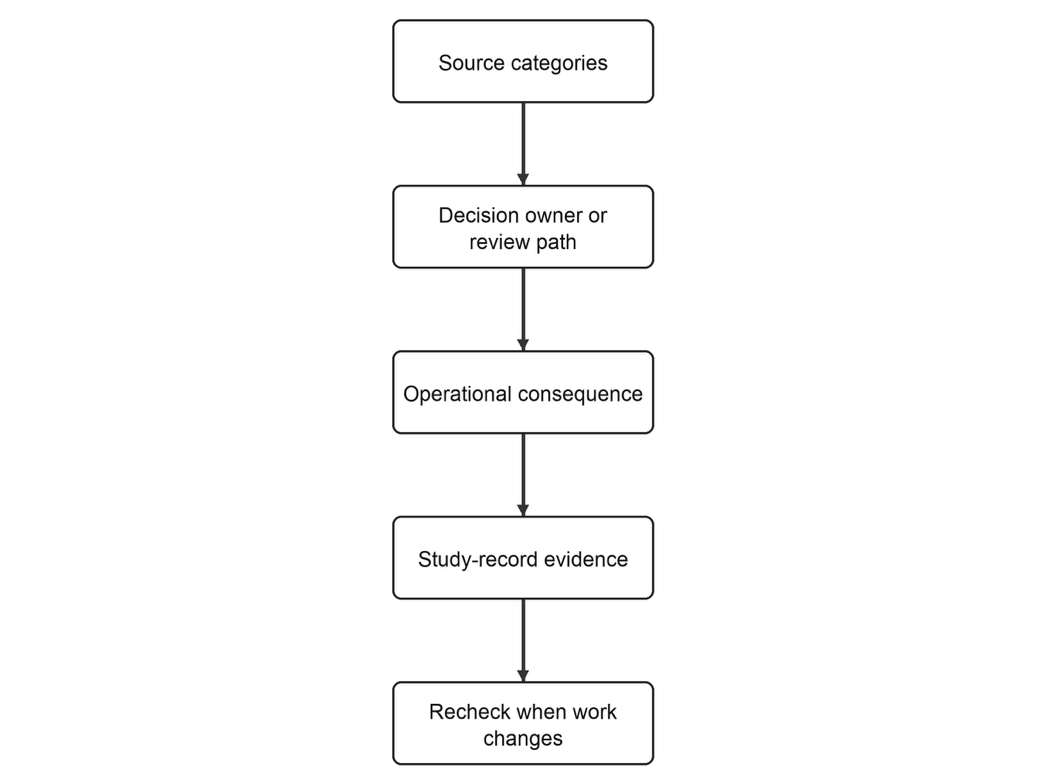
Clinical operations has to hold both risks at once. The practical middle ground is disciplined action. Identify the driver. Scope the issue. Find the right owner. Check whether a source controls the answer. Document the decision. Communicate the operational consequence. Escalate when the issue touches participant protection, data reliability, regulatory commitments, privacy, safety, product control, public records, or inspection readiness.
Disciplined action also means deciding what does not need escalation. A CTM may clarify a routine meeting action within the study team. Whether a regulatory meeting is needed for an operational correction depends on the issue, including when a monitor requests a missing file note or a coordinator corrects a scheduling typo. Over-escalation can bury the issues that truly need attention. The skill is separating a normal operational correction from a change in participant-facing conduct, source data, safety review, product control, consent, privacy, or regulatory commitment.
Use the sequence above as a mental prompt. Before acting, confirm that the identified owner can connect the affected work to its source and the evidence needed for the decision.
Enough working literacy helps each person avoid careless assumptions without memorizing every rule. A CRC should know when a consent or privacy question needs escalation. A CRA should know when a documentation issue may reflect a larger issue than filing. A CTM should know when a vendor issue affects participant-facing work or data integrity. A PI should know that delegation does not remove oversight. A data manager should know when source and operational workflow questions need site or ClinOps input. A regulatory partner should know when a submission or approval detail changes the work at the site.
Clinical operations needs to know when the answer is controlled and when judgment is required. It also needs to recognize an answer that belongs to another decision owner.