
Most trouble in clinical trial finance comes from seeing only part of the financial picture. A review can look orderly while operating details remain several steps behind the financial file.
A site has done work the agreement probably covers, but the remittance detail makes it hard to match payment to performance. A vendor has supported activity sitting at the edge of the original assumptions; an amendment has changed downstream work before the forecast has caught up. Finance is waiting on evidence the study team has not pulled together.
For the sponsor lead, this appears as forecast pressure. The site's cash-flow strain comes with administrative work, even as finance waits for the accrual support needed to close the period. None of these teams sees the whole problem.
That is where clinical trial financial management really starts; building the budget is a small part of the job. The harder work is keeping assumptions linked to payment evidence while the study moves.
Building the financial picture
Having an accurate approved budget and a statement of work that was sound at signature does not make an open, funded PO a complete financial record. Trial finance often fails in the gaps between these tools and the teams using them. Read the records together because each describes something different. The sponsor budget reflects the expected investment, and the site budget sets the agreed payment terms. The forecast is the team's current read on cost and timing. Actuals show what has been recorded, which usually trails some of the work on the ground.
These views overlap without merging. Before arguing about a number, identify the view involved and the decision it is meant to support. When a sponsor talks about the approved baseline while a site asks why payment has not matched completed work, they are answering different questions.
Clinical operations staff need to understand how their decisions shape trial costs. The financial picture starts with the protocol and pricing assumptions. Payment agreements and closeout records then show whether that early picture still holds as the trial operates.
Finance across the trial lifecycle
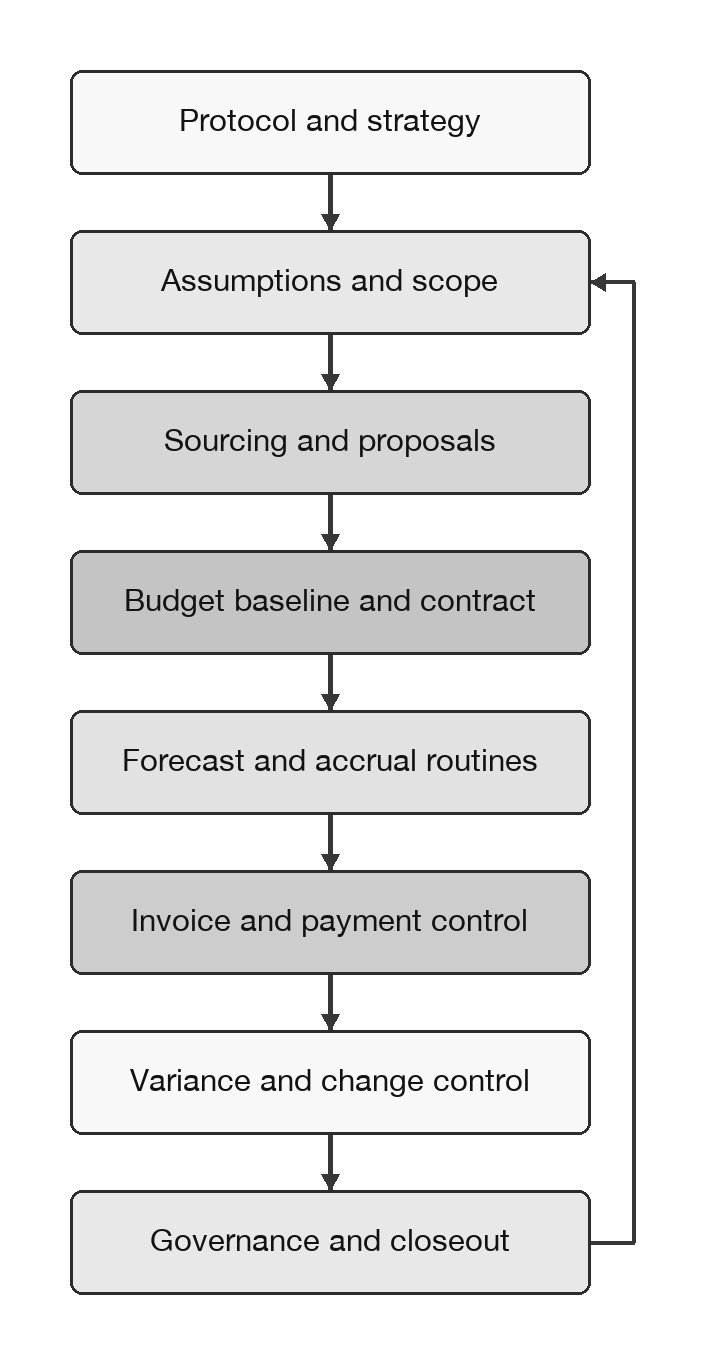
The budget gets treated as the starting line, yet it is only one point in a longer system. Before any budget exists, the protocol and study strategy create the work; assumptions convert that work into effort and vendor activity. Sourcing turns those assumptions into offers, and contracts freeze a baseline out of them. Later review asks whether the file still matches the trial. The details vary by sponsor and finance process, but the familiar weak spot is one stage losing contact with the next.
Small early gaps tend to appear late, often somewhere unexpected. A weak proposal assumption often resurfaces months later as a budget gap. Once work is underway, the commercial record carries that risk into the relationship. A vague payment trigger can invite a site dispute. A change order arriving after the work has grown can damage trust, even when the extra work was necessary.
The finance conversation needs to start earlier than invoice review. By the time an invoice shows up, no one is deciding whether the work belonged in the budget; they are interpreting whatever file exists. That file might be solid. It might instead be fragmented or late, and sometimes it points at the wrong baseline.
Keep assumptions visible while there is still time to act. Enrollment remains uncertain as sites activate at their own pace, and an amendment may require another look at the assumptions. Traceability is more useful here than perfect prediction because it shows how a number was built and what decision would be needed if reality shifts.
Separate the budget views
One useful habit in trial finance is to slow down whenever someone says "the budget." The phrase can mean an internal estimate or a negotiated site budget. In another meeting it may mean a vendor statement of work, forecast, PO amount, or recorded spend. Those views answer different questions.
The sponsor's approved baseline sets the authorized frame, while the negotiated site budget governs site payment. A forecast looks ahead, and actuals report what has been recorded. Accrual support estimates work done but not yet invoiced.
When those views collapse into one word, people talk past each other. The sponsor may call the budget on track because recorded spend sits below baseline, while the site, looking at payments that do not match its effort, reaches the opposite conclusion. They are holding different financial objects and using one word for both; pin down the object before arguing about the answer.
Financial roles and handoffs
Trial financial management is cross-functional because trial work is cross-functional. The money follows the work, and the work is spread across people and organizations.
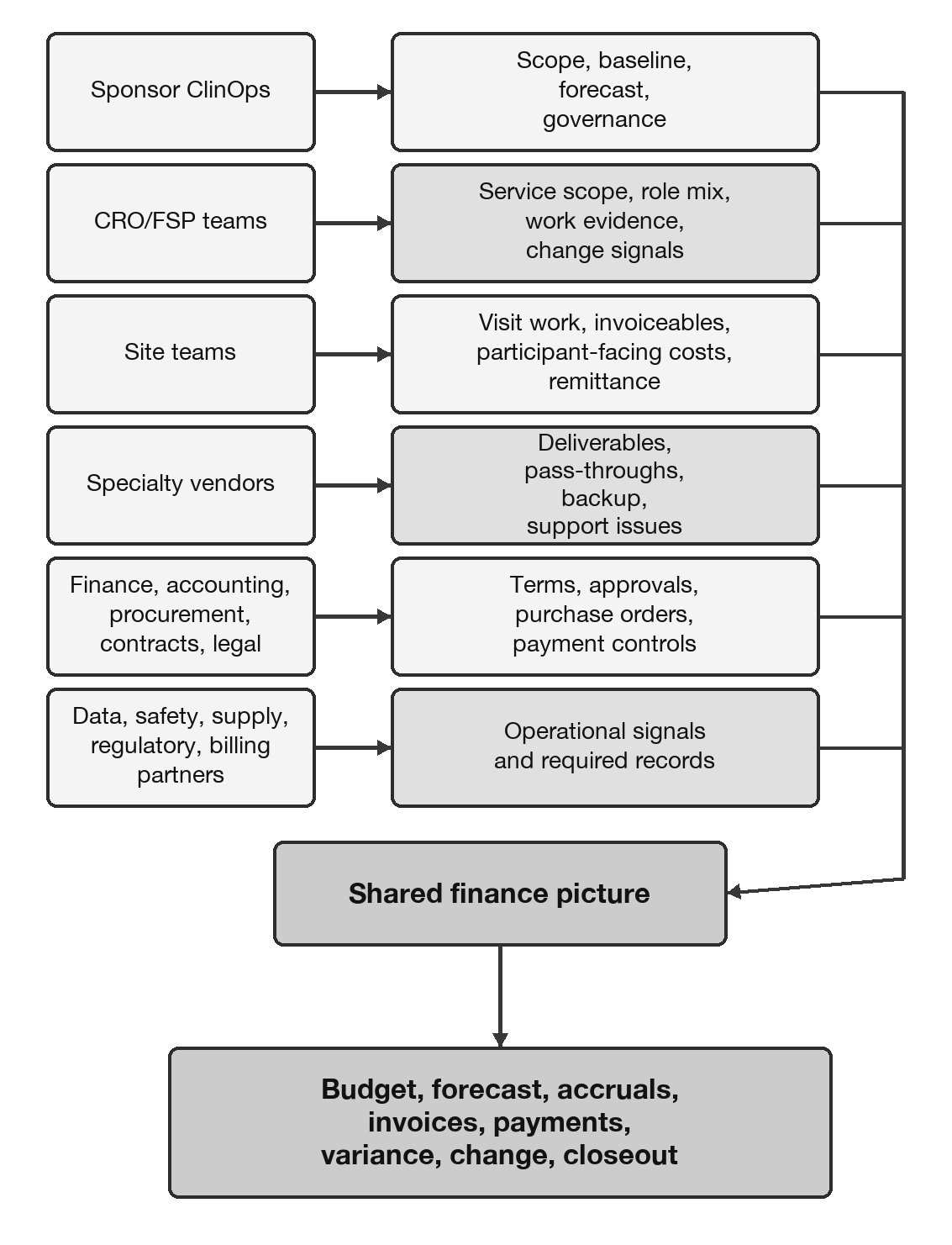
A sponsor clinical operations team usually holds the study-level view, while the CRO or FSP team carries delivery and cost-at-completion signals. The site runs visits under its own cash-flow pressure. Approval paths sit with finance and procurement, with legal involved in that structure. Each role sees only part of the picture, so the handoffs need to be deliberate.
The map describes a common situation and a recurring problem. The people who generate a financial signal are usually separate from the people who need it for approval or closeout. Most of this book lives in that gap.
A site may know a visit happened and an invoiceable procedure was done, while another team needs the event record before the financial consequence is visible to anyone upstream. A CRO can watch monitoring effort climb for weeks after a site slips, while the sponsor feels nothing until the forecast finally catches up and the number jumps.
Work moves before evidence moves
Site visits may occur before the payment file is complete, and vendor support may finish before its backup is assembled. This operating-evidence lag leaves finance waiting for evidence of work already done. An amendment creates a related lag when downstream activity changes before the budget and payment triggers catch up. Both are normal consequences of a financial system that usually runs a step behind operations.
The catch-up is where control slips. Late evidence, or evidence routed to the wrong place, leaves the team unsure whether a cost belongs in the forecast or invoice review. A real cost can still be hard to process; a variance can look favorable simply because the work has not been invoiced yet. Documentation earns its keep here. It ties a task to the financial decision behind it and shows what later moved the baseline.
Clinical operations should notice the financial evidence while work is still underway. Match a site's extra activity to a recognizable payment trigger, and establish the backup expected for a vendor's pass-through cost before it arrives. When scope drifts, that evidence gives governance an early signal, before a late argument puts trust at risk. By the time payment friction appears, the problem has usually been there for a while.
Why perspective matters
The issue reads differently from sponsor and site seats. A sponsor lead asks whether the study can still land inside the approved frame and whether the forecast tells the truth, while a site manager cares about accurate, timely payment for agreed work. The CRO lead sits between those interests and watches whether scope and role mix still match what is being done.
| Perspective | What finance often means in daily work | What the book should help them notice |
|---|---|---|
| Sponsor ClinOps | Budget baseline and forecast inputs | Whether financial signals match operational reality. |
| CRO or FSP team | Contracted scope and utilization | Whether the approved scope still matches the work being performed. |
| Site manager or director | Site budget and payment terms | Whether agreed work can be matched to payment and remittance. |
| Budget specialist | Procedure costs and charge-routing triggers | Whether the budget names the work and the payment proof. |
| Vendor project team | Statement of work deliverables and pass-through backup | Whether deliverables and costs show up before reconciliation becomes a cleanup job. |
| Finance/accounting partner | Period close and accrual support | Whether period-close inputs arrive in time to support reporting. |
The role table is only an orientation. A small sponsor will divide the work differently than a global CRO or an academic center.
Trial finance becomes strained when one team assumes another sees the same thing. The site expects the sponsor to connect a payment problem to the visit behind it, while the sponsor expects the vendor's backup to tie cleanly to the statement of work. Each expectation is reasonable from one team's position and problematic from another's.
A stronger finance culture gives people enough cross-functional awareness to raise the right question before a handoff fails.
Using the frame
The rest of the book follows that lifecycle; it opens with sourcing, because proposal quality drives budget quality. Request packages and vendor quotes establish the assumptions behind scope and pricing. When those assumptions leave work undefined, they can become a source of later change-order risk.
On an org chart these topics look separate; in a live study they run into one another. An unclear sourcing assumption may resurface as a change dispute; a weak budget structure may show up later as an invoice problem. A favorable variance sometimes signals progress. Other times it is delayed work the team has not seen yet.