
The first budget problem in a clinical trial usually appears after award, although it began earlier. The proposal total looked reasonable when the vendor was selected. Now sourcing has given way to start-up, and the delivery team is building the operating plan and preparing sites. The handoff gaps begin to show. One proposal assumed a lighter monitoring model; another vendor included system configuration in its price. Start-up support was priced, but its payment trigger is hard to find. The timeline counted on fast budget and contract execution without mapping the site-facing work to that assumption.
This familiar handoff failure occurs when procurement is treated as vendor selection without carrying its financial reasoning into delivery. Requests and bid defense materials can look like purchasing paperwork, and the final budget can carry the same administrative appearance. The team needs to read both the sourcing record and the budget as evidence of what the team knew and what vendors assumed before the baseline was fixed.
Budget work starts early
A clinical trial budget starts as a description of work. The protocol says what the trial is trying to do, and the sourcing package turns that into a request for capability and pricing. Vendors answer with assumptions about geography and site count. The monitoring model belongs in the response too, before the sponsor team converts the proposal into working financial records.
Clear assumptions give the handoff something solid to carry forward. Vague ones produce a budget that looks complete on the page yet cannot really be controlled.
The winning proposal becomes the trial's operating memory. It defines the work boundaries and records how units are counted, connecting that work to later payment or change review. Vagueness at this stage carries into the records used downstream.
Sites live with a related version of the problem. A sponsor or CRO can race through award and start-up, but site-facing finance moves on its own track. The site must know what visit payments cover and what it can invoice separately, with defined proof for each payment. Start-up and closeout handling belong on that list too. Lose those assumptions in the handoff and the site inherits a process that is documented but hard to run.
Early sourcing materials should explain why the contract and budget, including the statement of work, ended up looking the way they do.
How RFI and RFP evidence differs from RFQ evidence
These request labels are common, yet organizations use them in their own ways, so treat them as local. They are worth separating because each produces a different kind of financial evidence.
An RFI, or request for information, belongs early, while the team is still learning; it helps a sponsor size up vendor capability and capacity. What it cannot do is anchor a budget commitment, because the scope is usually still immature.
By the time the team can describe the work well enough to compare approaches, the request for proposal becomes the better instrument. A good RFP gives vendors enough shared context to make the responses comparable. Its financial value comes from that comparability.
The RFQ, or request for quotation, comes into its own once the scope is defined enough to price. It works well for stable services or materials. It turns risky when a team uses it to determine precise pricing around moving scope.
| Request type | Financial evidence and limit |
|---|---|
| RFI | Use an RFI early, while scope and the sourcing strategy are taking shape. It helps the sponsor understand vendor capability and fit by showing evidence such as capacity and experience, although broad capability responses should not stand in for a budget commitment. |
| RFP and RFQ | Use an RFP once the requirements are clear enough for vendors to respond against shared evaluation criteria. It compares each operational approach with the team's assumptions and governance model, but proposals cannot be treated as comparable when their underlying assumptions differ. An RFQ belongs later, when stable scope supports unit pricing for defined services under the stated timeline assumptions. Quoting a precise price while that scope continues to move creates a misleading level of certainty. |
Organizations may combine or skip sourcing steps and use different labels. Choose a request type according to the evidence required for the decision; local terminology does not change that requirement.
High-level responses are exploratory when the team is still learning the market. A quote needs scope stable enough for the number to mean something.
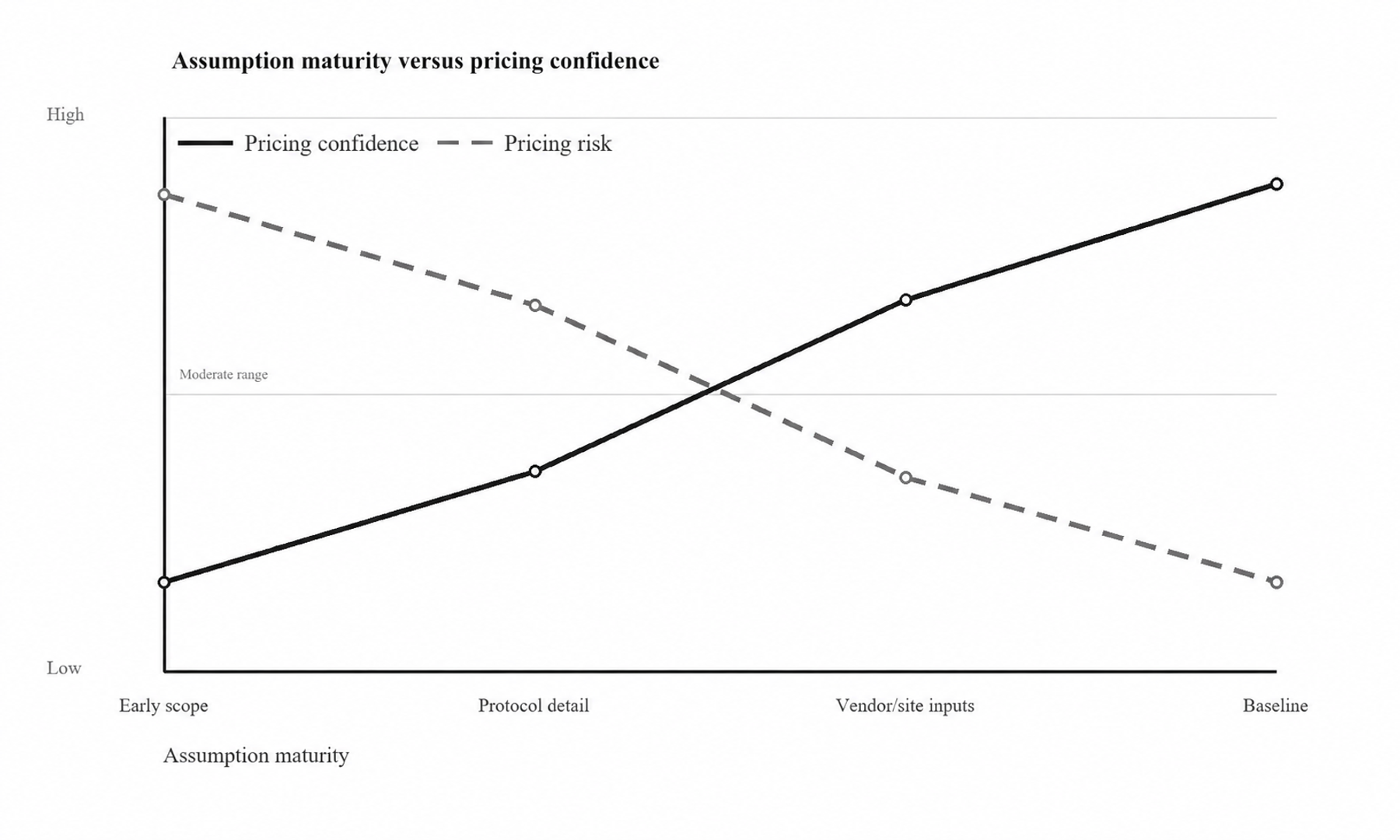
Comparable pricing requires comparable assumptions
Operating assumptions can explain why two proposals land on very different totals even when the pricing work is disciplined. One builds in more start-up support, while another assigns more internal work to the sponsor. Monitoring plans also differ if the sponsor pictured onsite visits and the proposal priced remote work. Country mix and closeout tasks can move the number just as much.
Hidden assumptions leave the team comparing different versions of the trial. Give vendors common protocol context alongside the site assumptions, so their responses can be interpreted together. Exclusions need a distinct place in the request package for vendors to interpret those assumptions consistently.
Different vendors will propose different ways to deliver the work. An experienced vendor may see a better approach than the request anticipated, so the team still needs to exercise judgment. Financial trouble starts when a price difference has no clear basis in the proposed delivery model or stated scope. The possibility of future change pressure needs its own review.
Assumptions need enough detail to survive the handoff, and the handoff has several audiences. The sponsor needs to know what it is buying; the delivery team needs to know what it owes. Finance needs enough structure for POs and invoice review, while governance needs a sense of which changes are large enough to reset the baseline.
When the proposal hides its assumptions, later conversations turn personal and defensive. The vendor says the work was excluded while the sponsor says it was expected. Finance sees a file that does not support payment. The missing assumption never became usable financial documentation, and goodwill cannot replace it.
Staffing is where this bites on large oncology programs. During pursuit, business development promises dedicated CRAs in each region or a senior project manager. Everyone nods before the budget is built on a junior shared-resource model. The delivery team inherits a contract it was never briefed on, and months later the sponsor asks why the people on the study are not the people it thought it bought. Nobody lied. The promise lived in a conversation instead of the budget. The team has to reopen the staffing assumptions in writing. That record becomes the basis for renegotiation. The work gets sorted out. The credibility spent in that first meeting is harder to win back.
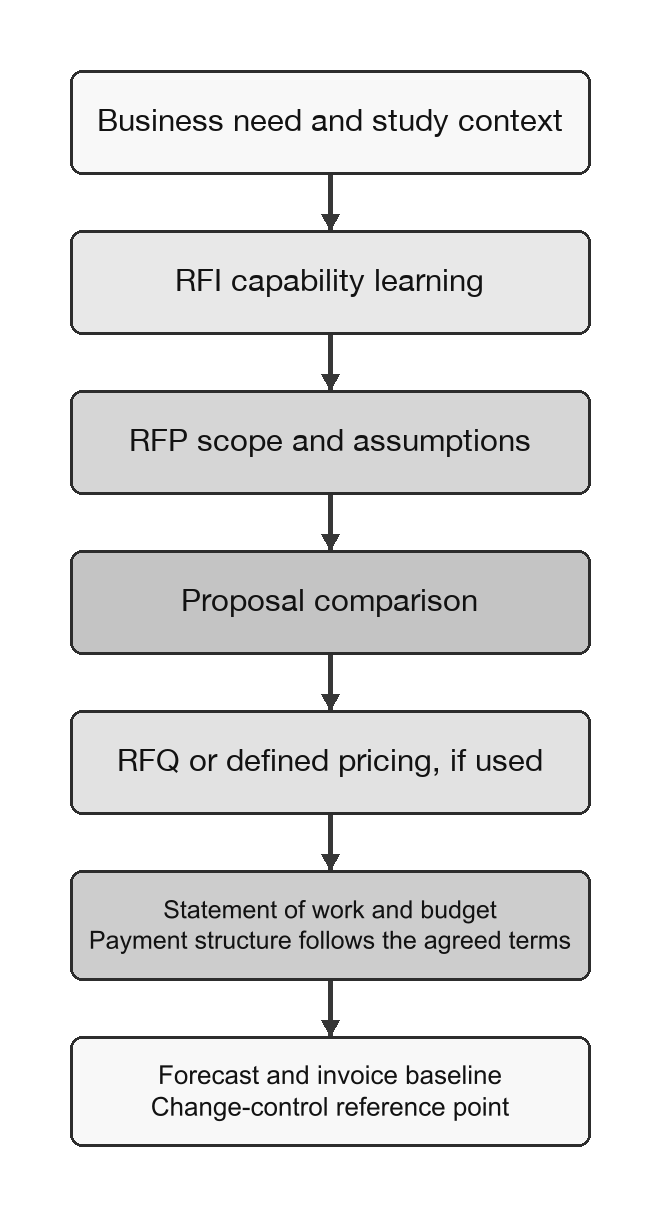
The handoff from proposal to baseline
Award begins the work of building the financial baseline. The selected proposal must now become controlled working documents, starting with a statement of work and an aligned budget. That handoff needs a disciplined payment structure with a clear path for invoice evidence.
Vendor selection leaves procurement logic that still has to be carried forward. The working budget needs the proposal's assumptions, exclusions, unit definitions, and payment logic. The diagram shows a simplified handoff path. Finance control depends on how much of that reasoning makes it into the working file.
Assumptions are especially easy to lose along the way. If the proposal counted on a certain number of sites or monitoring visits, the delivery team must inherit those numbers. Any later change should remain traceable to the inherited values.
Exclusions are often where future disagreement starts, so make them visible before work begins. The list varies by study and service type. Travel expenses follow the agreement's reimbursement terms. For the service-scope review, check translation exclusions against the agreed language scope and a custom-report request against the defined reporting deliverables.
Unit definitions deserve careful handling. A unit sounds obvious until the invoice arrives. A monitoring unit or lab kit needs a clear definition, because without one the team cannot tell whether the invoice reflects the agreed work.
An agreement may tie payment to a milestone or a countable unit, with the unit definition governing the latter. When payment follows elapsed time, the evidence and review process should match that basis.
Change review uses the same baseline. The trigger tells the team when movement away from that baseline should be reviewed. That movement may affect scope or schedule. Governance then determines whether either departure also moves cost. The trigger gives the team a route to decide before informal expansion turns into a standoff.
The handoff has worked when the proposal's logic is still visible inside the statement of work and payment terms. If that logic disappears, the team has lost something it will need later.
Start-up dependencies with financial consequences
Start-up requires financial readiness alongside operational readiness. Before enrollment, the site and study team may move through feasibility and site selection into budget review. CTA review and billing review follow when applicable, with training as readiness advances. Each step can have a financial consequence before the first participant enrolls.
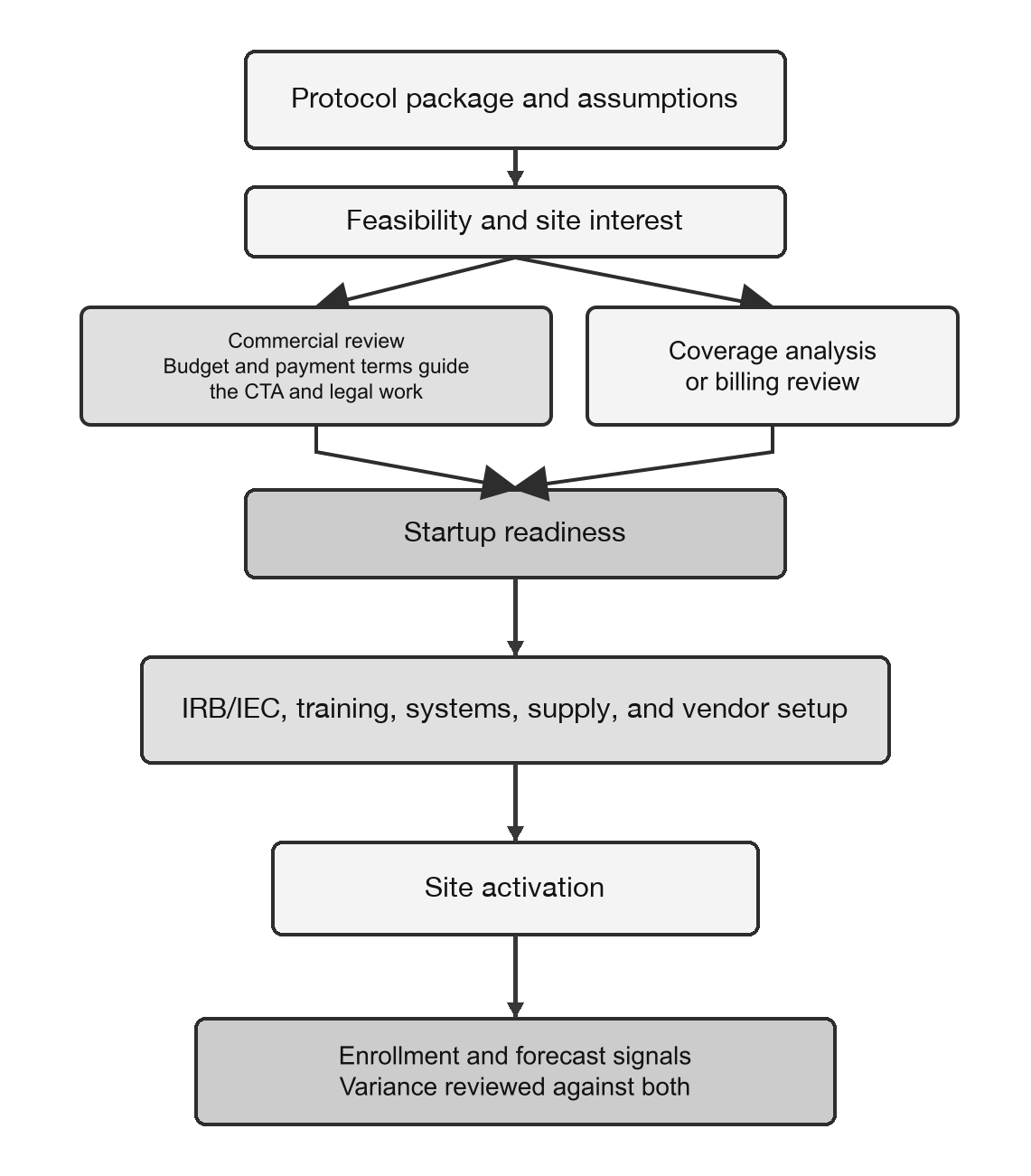
Start-up time accumulates across the teams. Site staff review the protocol and route the budget, bringing coverage questions into the work. As sponsor or CRO teams build systems with vendor support and agreements move through review, finance needs vendor setup and invoice triggers ready before routine work starts.
The start-up budget tends to fail quietly, because everyone treats this work as background noise. That is exactly why the dependencies have to be visible in the financial plan.
Start-up finance requires coordination between the site budget and the work around it. Payment terms need to match expected site work, with coverage or billing review shaping how protocol-required items are routed. The clinical trial agreement determines payment timing and invoice requirements, including how amendments are handled. The diagram illustrates these dependencies without prescribing a billing rule or legal sequence.
Training and systems can affect timing and the forecast. Supply or vendor setup delays can affect enrollment assumptions and financial variance.
The site angle is the one to watch here. Start-up work often begins before any visit payment exists. If start-up effort and admin work stay invisible in the budget, the site ends up carrying work no one can trace later. Participant-facing costs deepen that gap when the budget leaves them out. Payment depends on the agreement and the work actually done; site start-up effort still cannot be treated as free.
The sponsor and CRO side is just as exposed, because start-up assumptions drive the activation forecast. Treat budget negotiation and coverage review as generic tasks, and the forecast assumes readiness the file may not support. Contract execution can get flattened into that generic status; enrollment projections look better than they are. The cost pressure then slides into later months as variance or rescue work.
Finance experiences the same start-up gaps as payment and accrual friction. Start-up is the cheapest time to address them: the team can complete vendor and PO setup before invoices arrive, while payment terms are still easy to confirm. Once the work has happened, a missing setup step becomes a delay or dispute.
Start-up dependencies become financial dependencies when they change activation timing or site readiness; vendor setup and training can create that effect. Systems access or payment evidence can as well.
What to carry forward
Judge a procurement-to-budget handoff by whether it preserves the assumptions the team needs to manage the trial.
A handoff earns its keep when it explains how included work leads to payment. Flag any required pass-through backup within that explanation. Match the detail to the study. A narrow specialty service needs a lighter touch than a complex global trial with several vendors; either way, control comes from traceable assumptions.
Use the start-up tracker to identify unresolved preliminary enrollment assumptions and any dependence on contract or coverage work. If a site payment trigger is still taking shape, carry that uncertainty into the start-up assessment before assuming the payment process will be clear to the site.
Plain honesty pays off here. A labeled assumption remains useful because it preserves the uncertainty. During vendor selection, the same principle means identifying which price elements need later validation. Start-up can still move quickly as long as the file marks where it is genuinely thin. The danger comes when uncertainty gets written into the baseline as if it were settled.
Cost drivers and assumptions
Even a finished budget can hide a cost problem when the work behind the numbers is poorly described. The protocol may be drafted and the proposal received, with payment logic in the budget and a project plan that looks ready to execute.
The next questions concern what the trial will actually require. Participants need more support than the budget shows, and site staff coordinate far more non-visit work than the payment schedule admits. A technology tool carries build and support costs well beyond its license fee. Even routine-looking data work becomes heavy as database lock approaches.
Budgets compress assumptions into numbers, so the team needs to work backward until the work behind a number becomes visible again. The problem is rarely carelessness.
Assumptions become work
An assumption often becomes a future budget line or invoice question.
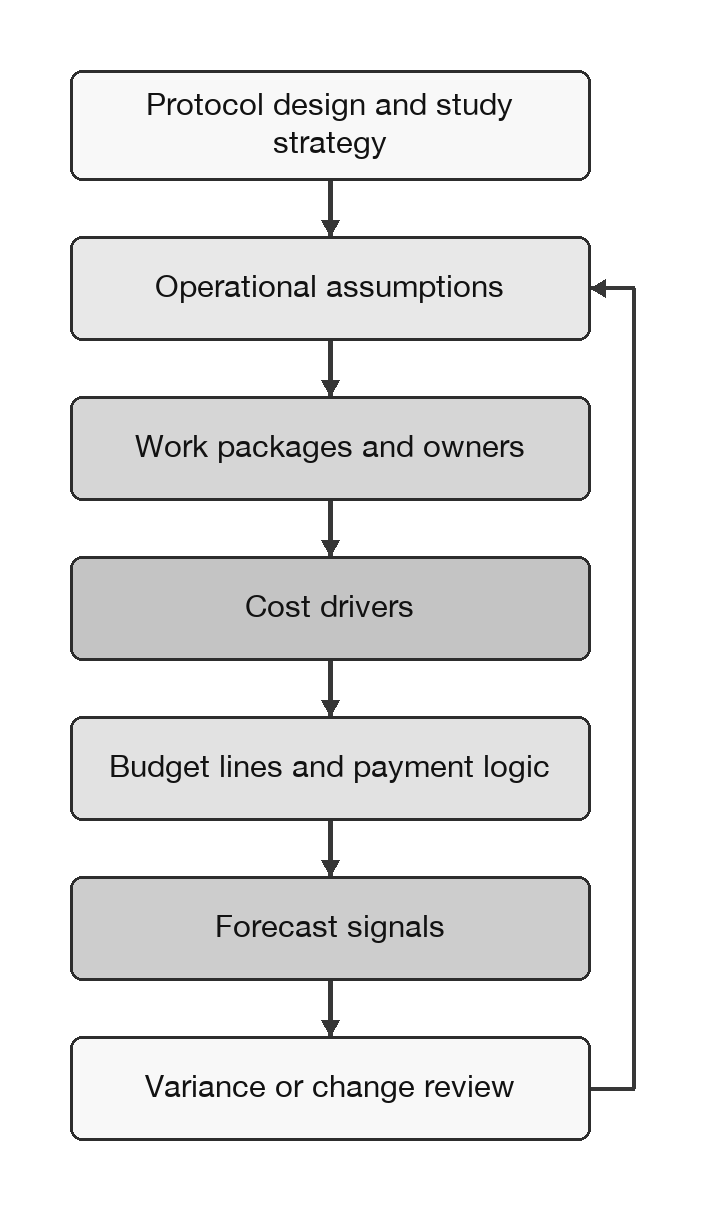
An assumption may concern site count, enrollment pace, visit burden, monitoring intensity, or amendment likelihood. Any of these can look harmless when written and become financially important once it creates work.
Cost drivers usually start as assumptions. Site count and visit design should be visible before they become budget variance. Data flow and supply needs deserve similar attention.
The diagram gives no ranking or weighting. Use it to follow an assumption forward until the resulting work is visible and its ownership is clear enough for financial review.
The habit guards against a common mistake. A budget can carry a clean total for monitoring or pass-throughs and still say nothing about which assumption drives it. When the assumption shifts, the team may not know whether the change is already covered. That uncertainty often becomes a debate about forecast update versus change order.
Ask how much the study costs and what that cost assumes.
Scope means the work people perform
Scope reads like contract language, yet it is really the work the trial asks people to do. At a site, that includes visit conduct and query response. A CRO may handle monitoring and start-up support, while a specialty vendor manages setup and data transfer. The sponsor keeps oversight of the whole system, even when the work is outsourced.
The budget must capture that work at the level of detail needed to assign the work and forecast it. Too little detail buries the cost drivers. At the other extreme, excess detail turns the budget into something nobody can manage.
Scope also includes boundaries. Exclusions are often where financial disagreement starts. The agreement defines whether translation work is included and which reports are standard. Requests for a custom report or additional monitoring need to be checked against those agreed limits. Excluded work still must be visible before the team needs it.
Scope boundaries get tested most when several organizations share the work. A vendor assumes the sponsor will provide a data specification; a site assumes the sponsor or CRO will pay for an invoiceable activity everyone treated as routine. Each assumption sounds reasonable from one seat and incomplete from another; good scope discipline makes the handoff concrete before it turns into a dispute.
Work breakdown without losing the work
A work breakdown structure, or WBS, divides a project into pieces that can be estimated and tracked. Project managers use it to identify the work people actually do in the trial.
A work breakdown keeps a budget from collapsing into one undifferentiated number. For information-system costs, the breakdown should distinguish data-management work on form design and database build from technology work on configuration and support. Clinical supply sits outside that category and requires a breakdown around how the product moves through sourcing and accountability.
A work breakdown identifies who performs the work and what proves it happened, along with the assumption driving volume and the payment path. A simple specialty vendor needs a light touch; a global study with many vendors needs more detail. In either case, a tidy label should still let the reader see the work.
Cost driver signals
Clinical trial cost drivers have no universal ranking because each study produces its own financial pattern. The participant pathway may dominate one trial. In another, the study context may place more pressure on supply or monitoring.
Participant burden deserves particular attention. It tends to get filed under ethics or recruitment, yet it is also a finance signal. Travel burden and reimbursement handling shape whether the budget reflects the real pathway through the study.
A site needs non-visit work as well as the scheduled visits covered by its budget. Safety-report review and unscheduled activity can create financial friction. Amendment work adds to that friction when no one names and reconciles it.
| Cost-driver area | What changes the work | Financial signal if missed |
|---|---|---|
| Site footprint | Activation pace determines how work unfolds across the planned site and country counts. | Sites that do not enroll any participants may still incur start-up and maintenance costs. And adding sites can raise start-up costs without changing the enrollment target. |
| Participant pathway | Retention support belongs in the participant pathway shaped by screening burden and visit frequency. | The effort per enrolled participant rises before the enrollment totals explain it. |
| Procedure and data burden | Account for biopsy requirements within the broader laboratory and imaging scope. | The site budget or vendor scope understates the required work, including the allowance for query handling and closeout. |
| Monitoring and oversight model | Define centralized review in relation to the onsite and remote monitoring model. | The forecast needs a separate site-interruption view alongside travel and document retrieval. |
| Vendor and technology model | Distinguish EDC setup from the combined eCOA/eConsent setup. | A visible license fee may conceal the work needed to configure and support the system, including reconciliation of its data. |
| Supply and logistics | Pharmacy work belongs in the product plan covering the investigational product and its comparator. | Pass-throughs or site fees appear late. Pharmacy and closeout costs may follow. |
| Change pressure | Treat new endpoints as a driver of amendment and re-consent work. | Forecast updates get mistaken for change approval. |
External data is another signal. Diagnostic services such as labs and imaging generate one category of setup work. eCOA follows a different path because its data can add transfer or reconciliation work. A budget that sees only the vendor fee misses the effort it takes to make the data usable.
Amendment sensitivity is the last item worth flagging here. A small-looking protocol change can travel through site budgets and vendor scope; data collection and supply may move as well. Amendment finance begins when the original assumptions are clear enough to show what changed.
The work around technology
Technology usually shows up in the budget as a license or platform fee. Sometimes it appears as a vendor fee. That visible number can make the cost look handled before the surrounding work has been priced.
Technology creates work around the tool itself. A study may need configuration and user testing, along with access management and training. Help desk questions and data transfers create another layer of work that was left out of the first number. Responsibility is scattered across the vendor and sponsor, often with a CRO or FSP team in between. The financial risk comes from assuming that technology automatically makes a study simpler. Whether the technology is good or bad is a separate judgment.
Decentralized and hybrid elements create similar movement. A remote-visit model, whether telehealth or home health, can lift one burden while adding another. A wearable introduces the same budget question through a device workflow in some trials. Ask where the work moved and whether the budget followed it.
A participant-facing tool can be hard to use when connectivity or language becomes a barrier. The usability problem becomes site work when staff train users and troubleshoot access, even if the tool looks efficient to the sponsor. Caregiving demands create a separate participant burden.
Budget technology as a work system. Its cost follows setup and support through closeout.
| Technology work area | Examples | Finance signal if underestimated |
|---|---|---|
| License or platform fee | User counts belong in the license estimate for the study build and its modules. | License cost covers only part of the technology work. |
| Build and configuration | EDC form work belongs to configuration, while the participant-facing build covers eConsent and eCOA. | Start-up timing stretches and vendor hours rise. |
| Access and training | Keep participant access separate from the study-team plan, which covers site users together with the sponsor/CRO side. | Support and retraining become recurring work. |
| Device and connectivity support | Replacement planning belongs in the support model for provisioned devices and BYOD. | Participant burden and support tickets affect retention and cost. |
| Data transfer and reconciliation | Vendor feeds, monitoring, queries, archive/export | Closeout or database finalization lags study conduct. |
Monitoring and quality work move cost
Monitoring strategy contains financial assumptions that can be easy to miss. A study may combine onsite and remote monitoring for visit-based work, with centralized review as a separate part of the model. The model affects monitor time and document access, creating record demands that continue into closeout.
Remote or centralized monitoring trims some travel and onsite time, but it pushes work elsewhere. Sites end up uploading documents and answering remote inquiries, while the CRO or sponsor side leans harder on central review and data reconciliation. When that redistributed work requires platform access, vendors may be pulled in to provide it.
Financial signals may include monitor effort beyond the baseline or site-facing work heavier than the budget assumed. Data issues force rework. A quality problem may require remediation, and closeout can stretch when records are not ready.
Those signals need careful routing before the team decides whether change-order treatment applies. The right move comes from reading the agreement and baseline against the evidence.
Clinical supply cost chain
Clinical supply often gets reduced to whether the product or comparator is on hand; device and kit availability can get treated that way too. Availability matters. The cost chain runs a lot longer than that.
| Supply work area | Finance question to resolve | Evidence or handoff to watch |
|---|---|---|
| Product or comparator sourcing | Payment source for acquisition and matching, including placebo or replacement supply | Use the sourcing record to document the review of the sponsor supply plan against the vendor agreement. |
| Packaging and labeling | Include blinding in the packaging and labeling scope. Treat country-specific needs within the setup and change scope. | Use the change record to document how the packaging and labeling plan stays aligned with IRT setup. |
| Depot and storage | Include temperature control in depot and storage planning. Define ownership for storage and resupply, including monitoring or excursion follow-up. | Keep shipment activity in its own record, separate from the depot record and temperature log. |
| Site pharmacy or IDS work | Dispensing work belongs within local start-up and storage planning. | The site pharmacy handoff should link the budget and accountability logs to the supporting closeout evidence. |
| Return/destruction or other disposition | Disposition path for unused or expired product | The closeout checklist should point to the return or destruction record and its sponsor instruction. |
Supply planning includes product sourcing and packaging. Depot storage and temperature monitoring may sit behind it, with courier work or reconciliation after that. Name the pieces early because supply assumptions shape start-up and enrollment. At closeout, their downstream effect depends on how the study handles reconciliation.
Supply also moves with enrollment and amendments. Faster enrollment pulls supply forward; slower enrollment creates expiry pressure. A change in country mix reshapes packaging and shipping while creating separate local setup work. Closeout often brings reconciliation work long after the last participant visit.
Supply activity includes site pharmacy work and storage, with sourcing and logistics visible to sponsors and vendors. Finance reads that combined activity through pass-throughs and closeout reconciliation. Each group encounters those supply movements differently.
Clinical operations professionals can handle this well without becoming supply-chain specialists. The operational need is visibility before a pass-through or delay forces the issue, and reconciliation problems should not be the first signal.
When assumptions move toward change control
A missed assumption can require mitigation or a forecast update. Invoice questions and operational lessons may expose the issue, which becomes a genuine scope change in some cases.
The baseline and supporting file determine the path. Included but underestimated work calls for a forecast update and mitigation plan, while excluded work now needed requires scope and change review. A murky payment trigger belongs in invoice or contract clarification. A protocol amendment usually ripples through budget and forecast before reaching site terms.
It helps to resist the jump from cost pressure to blame. A forecast update has a different purpose from a change order. A variance describes movement from plan and does not establish poor performance; even a favorable variance can hide delayed work. Operational efficiency needs similar caution because technology tools do not guarantee it, and decentralized elements may fall short of expected savings. Separately, a quality issue creates no payable event by itself.
When a finance issue surfaces, trace the work back to the assumption that created it. Connect the supporting documentation to the budget line before checking the payment logic, and escalate if the baseline no longer fits. Record the decision so the next person reading the file can understand it.
Once a team can see the assumptions and the work beneath them, the budget becomes easier to interpret and govern. Most budgets that fall apart in conduct were already hard to read on the day they were approved.